Tuesday, April 26, 2011

 
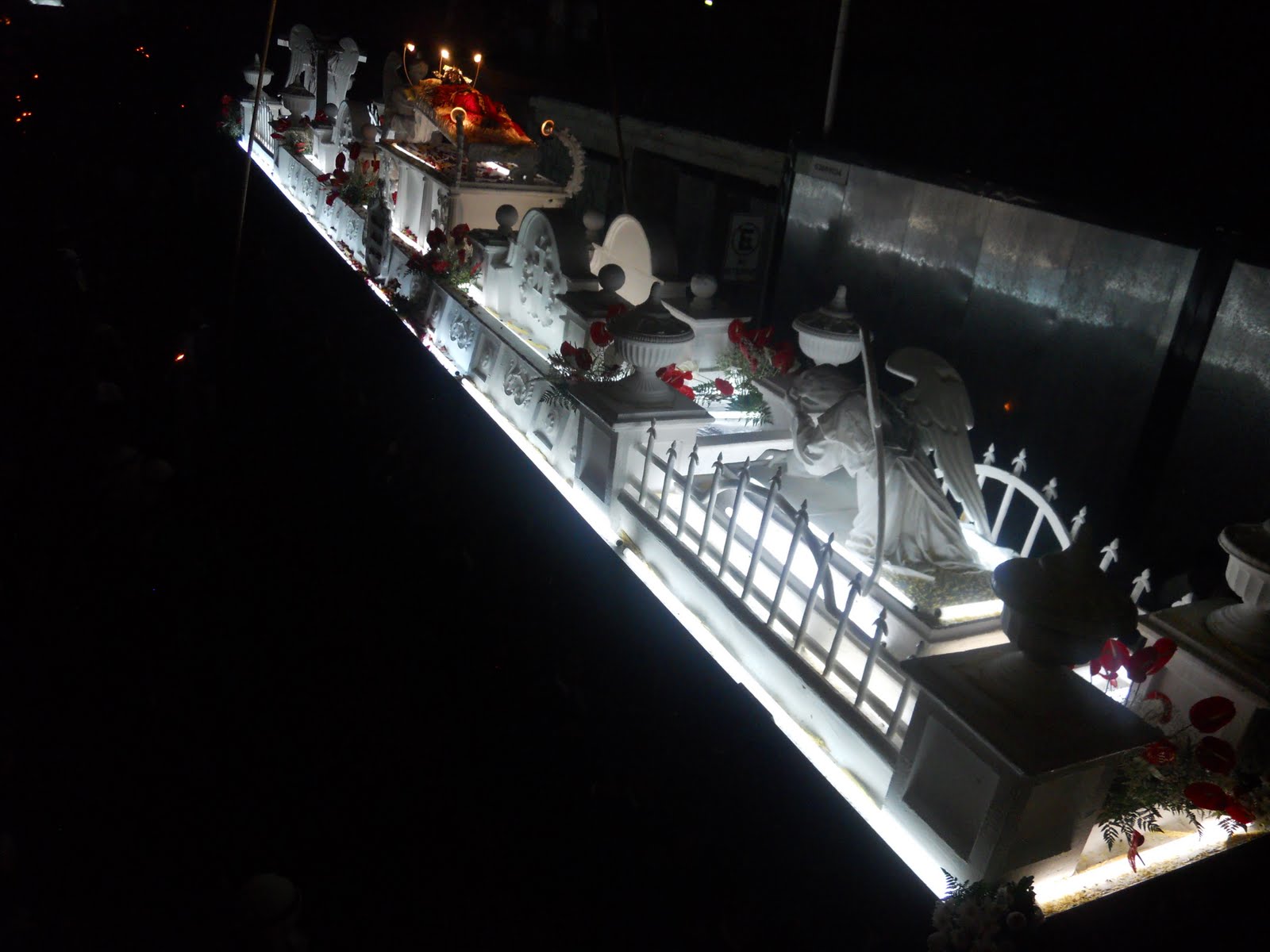
As a Lent tradition, alfombras, or carpets, are created in the streets of Guatemala, specifically during Holy Week.  The alfombras are laid down as a welcoming symbol for the arrival of Jesus, similar to the palms in religious tradition.  Originally made from flowers and feathers in the 1500’s, the process rooted in Spain often causes roads to be blocked off for hours at a time.  The entire Catholic community participates in the process.  Each person’s ‘plot’ in front of their home or place of work is decorated with pride.  Today, the majority of the alfombras are made with colored saw-dust and sands, but are decorated with candles, flowers, foods, statues, you name it…  A procession takes place throughout the town, in which varying numbers of ‘floats’ are carried by hundreds of men.  I was told being able to carry the large Jesus float, symbolic of the carrying of the cross, is a major honor in the religious community.  Check out some fotos from the week:


Friday, April 15, 2011

And sometimes Y

A,E,I,O,U & sometimes Y. This is a phrase my weekly English class of middle-aged students and soon to be tour-guides have repeated over and over.  Every word is made up of consonants and vowels; there is at least one vowel in every word.  The Y was initially left out by the students when learning the vowels early on.  Students often want to jump to the finished word or phrase- as we as humans may instinctively want and only analyze the final product, service, ability, or effect.  The Y, or WHY, is something that has become relevant in many projects I am currently undertaking.  The cause is often times the most overlooked and integral aspect that needs to be changed.  Students may be having trouble because they do not understand the opposite adjective-noun placement in the English language, the differing base sounds that form words, or how to make the ‘th’ sound.  Kamille and I have made fools of ourselves sticking our tongues out to teach and stress ‘th’is aspect of pronunciation.  Without analyzing, asking and solving the why, we are merely constructing a palace on unsteady ground.   This basic concept transfers over to a number of areas. 
The dental workshops we have conducted are aimed to educate kids on the importance of mouth hygiene through brushing and flossing both properly and regularly.  In addition to preventing dental caries, dental hygiene – or more simply- healthy teeth are necessary for eating and talking.  On an inevitable superficial scale, appearance affects job opportunity.  Likewise, overall health affects long-term availability to work and productivity while present.  The message can be skewed that toothbrushes are the solution, but this is not the case.  Behavioral change, one of the harder tasks one can face, is where the problem lies.  Lack of access to health-care undoubtedly plays a role in the shockingly high number, an estimated 60% of rural children currently have some sort of tooth decay, but this is not the entire cause of the epidemic.   Excessive snacking on junk-foods, lack of education on nutrition, and soda (”water”) being the regular cheap drink of choice by children are the roots of where the problem lies- the why- and for this reason are the areas we are targeting to create an increased awareness and understanding about.

Empty bottle+ plastic bags+ chip wrappers+ a little effort= ‘eco-brick.’   Gather and create thousands of these +cement + wire +metal slabs for the roof +a lot of hard work + community teamwork and bonding and you have a school.  (Add in NGO support, specialty workers, etc.. you get the drift).  The Chibulbut School is currently collecting plastic waste and forming these ‘eco-bricks’ to be used in the construction of two schools in Lachua, Alta Verapaz, to the north closer to Mexico. The project promotes community leadership, ignites a sense of ownership and mutual identity with the children who aid in constructing it, and uses garbage, in effect cleaning streets along the way – it is an ingenious thing. 
Despite this fact, especially with my school that is collecting the materials for schools being built elsewhere, a disconnect for my students has been the why.  Yes, the filled bottles will create a school.  Yes, the streets where they collected the waste are cleaner in this moment, but it is not merely about filling the bottle.  No, you should not buy more Tortrix chips if you are short on wrappers to complete an eco-brick.  No, plastic bottles should not be a priority to buy in the future because you can construct things out them.  Plastic bags are not biodegradable, light merely breaks them down into smaller and smaller particles that contaminate the water supply and soil.  Likewise, plastic bottles do not decompose for thousands of years.  The goal is to construct a place to learn, while fostering environmental learning in the process...to turn a negative into a positive with hopes of gradual behavioral change and understanding for the next generation.   
 
Growing up, my mom always played a video entitled “Everybody Poops” for the children she watched in daycare.   I can still recall the chorus line- She is a super-duper-pooper™.  Everyone does indeed poop, but not everyone has a sanitary location to do so.  This past week I met with community leaders I will work alongside to complete the training and construction of 14 latrines, with the same number of rural families.  The two communities, Santa Ine’s Chicar and Caserio el Salmar, will each have seven families participating in the SPA (Small Project Assistance- USAID) funded project.  Having a seat and semi-private place to defecate is certainly an aspect many of these families will thoroughly appreciate. 
Again, there is an extreme underlying why.  In the coming weeks we will be holding workshops with the families explaining the maintenance, upkeep, process, and reasoning behind the importance of sanitary waste management.   Over 15% of early childhood deaths are due to diarrhea, over 2/3 of the time the result of inadequate sanitation.  Chronic diarrhea has also been known to compromise development and growth, leading to increased chance of illness down the road.  Numerous studies have demonstrated a strong association between improved latrines and reductions in diarrheal disease, with the improved latrines yielding results of increased height and weight among children users.  Improved sanitation is a large step towards a healthier and happier community.
 
Looking at the big picture, or examining the why, is beneficial in almost all problems and situations.  I have recently been contemplating how this cause-effect mindset can be applied to other activities and lessons, including our tourism alliance, customer service practices, and  the planning of a recycled materials playground/trainings at the cooperative school.   I have also been sparked to think in reverse, to the life I left behind.  I am in constant contact with families who have dirt floors and minimal food, but they are undoubtedly happy.  The why.  This introspection is something I hope to apply to my life into the future.  Ultimately, the power to create change is within each individual. As I’ve told many of my students, you do not need one of the common A-E-I-O-U vowel words to do so, but a positive attitude and to T-R-Y, where the sometimes y is applicable.


Thursday, March 17, 2011

Reducir, Reusar, Reciclar


Promoting proper trash management and recycling in a culture where it is common practice to throw wrappers on the ground can be a strenuous and tiresome task.  (Ok, corny joke out of the way.)  In the United States alone, on average upwards of 300 million tires are disposed of annually, of which nearly 30 million are estimated to be left in landfills.  Because of their extreme durability, amount of time to decompose (over 100 years), toxins released into the air and soil if burned, and extremely high number,  tires are one of the more problematic wastes in the world. 
The durability of tires also presents great opportunity for recycling, whether that be re-using the rubber for future tires (which only  uses 30% of the energy needed to make a new tire  , in effect reducing oil usage) or using them in everyday projects.  We did our part this past week at the Chibulbut School, using tires to construct six tire gardens.  Each grade is maintaining their own mini-garden, grades one to six.  Between the six classes we are growing carrots, cilantro, and beets. Kamille plans to use the crops to make healthy snacks for the kids to use as a supplement to nutrition workshops she will be coordinating.  The projects roll on….


Friday, March 4, 2011

Alabama, Arkansas..... HOME!


  The song ‘Home’ by Edward Sharpe and the Magnetic Zeros has naturally become a group favorite in the department of Alta Verapaz.  Whether sung with a guitar beside a bonfire, whistled down a dirt road, played on repeat via I-pod , or belted in harmony while out together during the state of siege, it has become a quasi- theme song over the past few months.  After an exhausting 65 days out of site, since December 20th, I returned exactly there this past Wednesday- home to the Chirrepeco Tea Cooperative.  Only six volunteers will now remain, as a handful of others have returned stateside, moved to different departments, or taken on other work within the country.  One volunteer named Nick particularly enjoys loves the song Home, but unfortunately will not be permitted back to his site.  Fortunately, in the midst of two bottle-school projects (and being one of the funniest people I’ve ever met), he will be permitted to return back sporadically in the daytime to oversee the completion of these projects.  
Newly painted office
Finishing up the Chirrepec sign project
Over the two-month siege another volunteer’s mom had visited.  Unable to go visit their site, they explained that although it was great for her to see Guatemala and different tourist destinations within different areas, it was hard not to be able to show off their home- a place that will inevitably always be a part of them.  Over the past two months, despite moments of anxiousness and frustration, I thoroughly enjoyed  and benefited from various activities; Spanish classes, assisting build a school out of recycled bottles, youth development help with an ngo, mid-service medical check-up (TB FREE!),and  attending my first ladino wedding.  I undeniably enjoyed these experiences, yet they still were not home- I continually yearned to return.  Chirrepec has similarly and descreetly  become a part of me.

 Roof Inauguration 2,011

It is now a new year, there is a newly instated military presence in the region, a new group is soon to be sworn in (none will be sent to our region), and a handful of us remain—as always change is the only constant.  All one can do is roll with the punches moving forward.  In my short time back at site work is steadily moving forward.  I will be undertaking a SPA project (Small Project Assistance Program) of a volunteer who returned stateside.  Over the next few months, I will be overseeing a latrine project within a community located a little over a half an hour from Coban.  Upon returning to the Co-op, I found my co-workers painting the offices and salon, part of the yearly work-plan we had written up.  As part of Kamille’s Peace Corps Partnership project, a new lamina roof was put on the Chibulbut School while we were away.   Just weeks before, a number of openings and cracks allowed for rain to form puddles in the four classrooms.  New windows are set to be put in within March, as well.


           Likewise, The Viviente Verapaz tourism alliance held meetings while we were away.  Winfrey, from Alabama Arkansas, and I are the only two remaining tourism volunteers in the region/ working with the alliance.  Although this is a challenge, it is a good step towards sustainability and self-management into the future.  We are currently in the process of forming an alliance webpage, setting up a promotion event in Antigua, networking with a few new NGO’s, and organizing a training workshop in May.  A few of the activities for the upcoming weeks include a dental/floss workshop with a local school, tire-gardens, nutrition/ cooking sessions with the women’s group on International Women’s Day, sign projects in two neighboring communities, TEFL  classes in my two communities, putting the new windows into the school, and a 50th year PC gathering at the ambassador’s home.
My training host family and I at the wedding


My godson- Selvin Jr.
I am elated to continue working with my community.  I am cognizant of how much I have —and how that can be taken away in the blink of an eye.  I am happy to see my godson, Selvin Jr. on a daily basis.  I have a lot of work to do.  I only have a year remaining.  I am ready. I am excited.  I am content.  I am home.